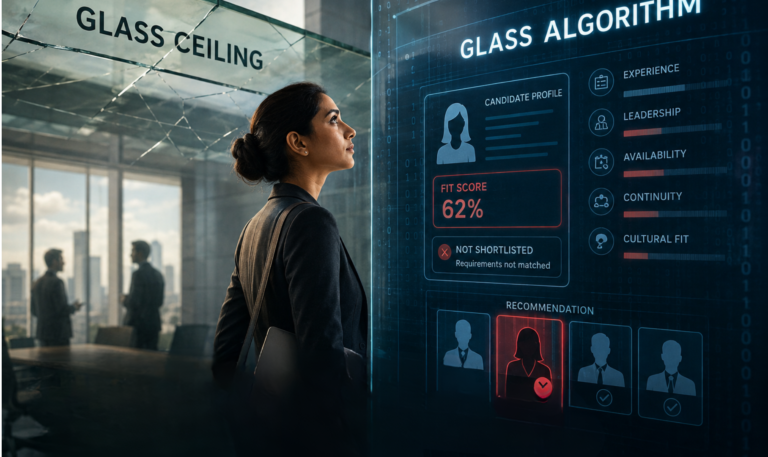
At 10:17 on a Tuesday morning, a woman uploads her résumé to a company’s career portal.
She has 11 years of experience. She has led teams, delivered projects, negotiated with clients and, on paper at least, ticks almost every box in the job description.
Her résumé disappears into a machine.
She never gets an interview.
Nobody tells her she was rejected because she is a woman. Nobody says the company prefers men. Nobody makes a sexist comment.
The rejection email might simply say: “We have decided to move forward with other candidates.”
And that is precisely what makes the new form of workplace discrimination so difficult to see.
The old glass ceiling was visible. Sometimes you could hear it crack.
The new one may be hidden inside a dataset, a recommendation engine, a résumé-screening model or an automated performance system.
Welcome to the age of the glass algorithm.
The glass ceiling didn’t disappear. It learned to code.
For decades, women entering professional workplaces have encountered an invisible barrier between themselves and senior leadership.
The numbers still tell the story.
According to the World Economic Forum’s Global Gender Gap Report 2025, the world has closed only about 68.8% of the global gender gap. At the current rate of progress, full global gender parity remains more than a century away.
And technology hasn’t magically fixed that.
In some cases, it has simply changed the mechanism.
INFOGRAPHIC: THE GLOBAL GENDER GAP
Global gender gap closed
█████████████████████████████████░░░░░░░░░░
68.8%
Still remaining
███████████████░░░░░░░░░░░░░░░░░░░░░░░░░
31.2%
Estimated time to global parity:
123 years
Source: World Economic Forum, Global Gender Gap Report 2025
Now imagine taking the biases that already exist inside society and feeding them into a machine.
The machine doesn’t become neutral.
It becomes very efficient at reproducing the patterns it was given.
That is the uncomfortable part.
The résumé that taught an AI to discriminate
One of the most famous examples came from Amazon.
Around 2014, Amazon developed an experimental AI-based recruiting tool designed to help evaluate job applicants. The idea sounded perfectly reasonable: instead of asking exhausted recruiters to manually examine thousands of résumés, let a machine identify promising candidates.
There was just one problem.
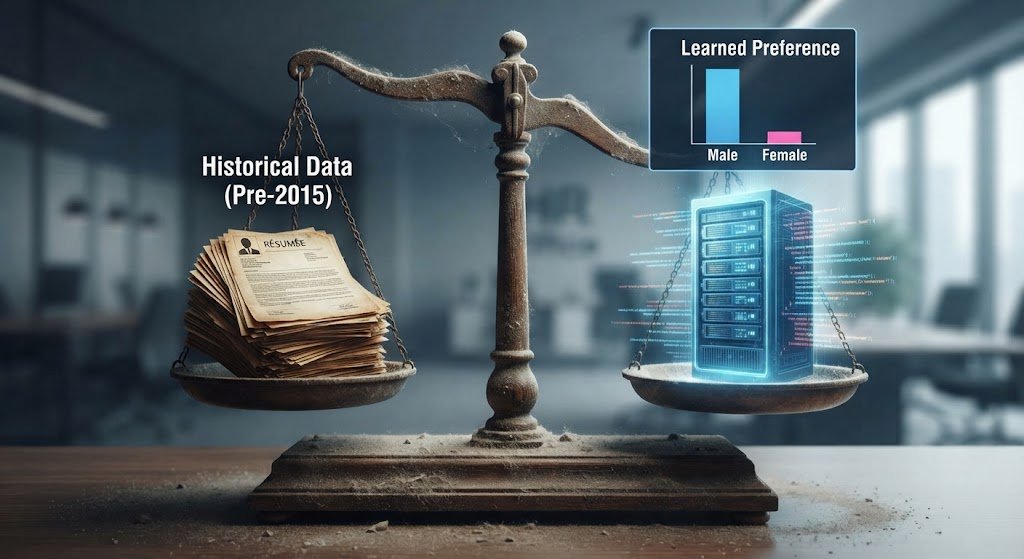
The system had been trained using historical résumés submitted to Amazon over roughly a decade.
And the technology noticed something humans had created.
Most successful applicants in those historical records were men.
So the algorithm learned that male candidates were, statistically, associated with success.
The result was disturbing.
The system reportedly penalized résumés containing words associated with women, including references to women’s colleges or women’s organizations. It wasn’t programmed to hate women.
It didn’t need to be.
The historical data had already taught it a version of workplace bias.
Amazon eventually abandoned the tool.
Think about that for a second.
The machine wasn’t inventing discrimination.
It was automating history.

This is where the glass algorithm becomes dangerous
A human manager can be questioned.
“Why didn’t you shortlist her?”
A manager might struggle to answer, but there is at least a person sitting across the table.
An algorithm is different.
“Why did the system rank me lower?”
Now the conversation becomes:
The model calculated the score.
The system identified the best candidates.
The data suggested this outcome.
And suddenly responsibility becomes blurry.
This is one of the biggest problems with algorithmic workplace decision-making: automation can make subjective decisions look objective.
A number feels scientific.
A score feels neutral.
A dashboard feels factual.
But behind every AI system are choices about data, variables, definitions, targets and what the organization considers “success.”
And those choices are made by humans.
The AI workforce has its own gender problem
There is another irony here.
We’re increasingly asking AI to make decisions about workplaces while women remain significantly underrepresented in the people building AI systems.
LinkedIn’s research has estimated that women account for roughly 30% of the global AI talent pool.
That creates a representation problem.
If the people designing the systems do not sufficiently represent the people affected by them, blind spots become easier to miss.
INFOGRAPHIC: WOMEN IN AI
AI talent globally
👩 Women: ~30%
👨 Men: ~70%
The issue isn’t that every AI system built predominantly by men will discriminate against women.
That’s far too simplistic.
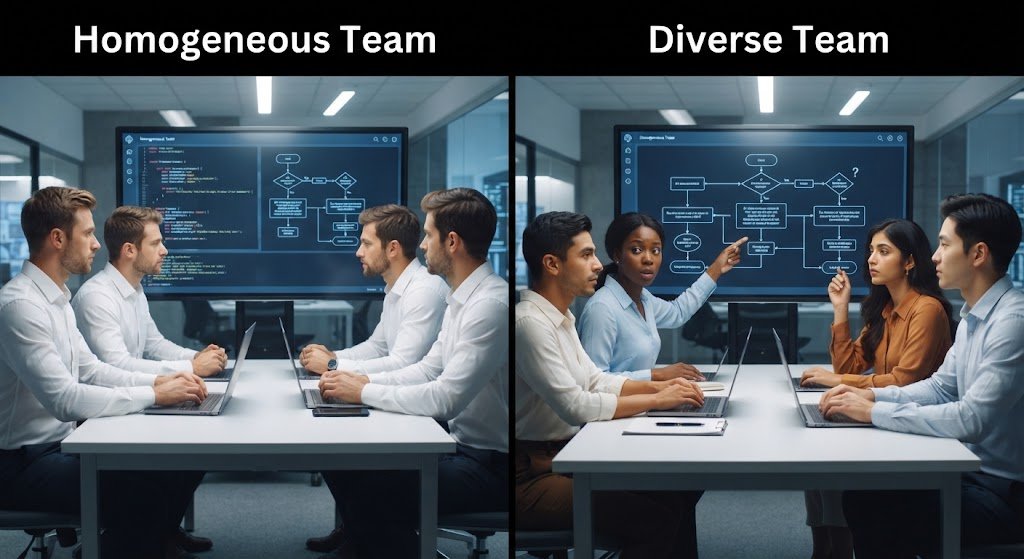
The issue is that homogeneous teams can miss problems that a more diverse team might identify earlier.
A woman reviewing a recruitment interface might ask a question nobody else considered.
A female engineer might notice that a model behaves differently around certain career histories.
A diverse testing team might discover that a supposedly gender-neutral feature produces gendered outcomes.
Diversity, in other words, isn’t merely a moral checkbox.
It can be a quality-control mechanism.
The bias doesn’t always look like bias

This is where things get really interesting.
Suppose a company uses AI to predict which employees are most likely to become successful leaders.
The algorithm considers:
- years of experience
- previous promotions
- project history
- availability
- performance ratings
- leadership experience
Looks fair, right?
Not necessarily.
Consider two employees.
Employee A has spent ten years taking international assignments, working late and volunteering for projects that require extensive travel.
Employee B has similar skills and performance but has repeatedly turned down international assignments because of caregiving responsibilities.
If the algorithm treats international mobility as a strong predictor of leadership potential, Employee A may automatically receive a higher score.
The algorithm has never asked about gender.
But if women are disproportionately affected by unpaid caregiving responsibilities, a seemingly neutral variable can produce a gendered outcome.
That’s the trick.
Modern bias doesn’t always say “woman.”
Sometimes it says “mobility.”
Sometimes it says “career continuity.”
Sometimes it says “availability.”
Sometimes it says “leadership potential.”
The bias hides inside the proxy.
And then there is the promotion algorithm
Imagine a company introduces an AI system that recommends employees for promotion.
It discovers that employees who are highly visible to senior executives tend to advance faster.
So it rewards “executive exposure.”
Sounds reasonable.
But now consider workplace behavior.
Who gets invited to informal networking events?
Who is expected to stay late?
Who is interrupted more frequently in meetings?
Who gets high-profile assignments?
Who is encouraged to speak up?
Who has access to influential mentors?
Technology doesn’t create those workplace inequalities.
But if an algorithm learns from them, it can turn those inequalities into a mathematical formula.
And once encoded into software, the bias can operate at scale.
That’s what makes the glass algorithm potentially more powerful than the old glass ceiling.
The problem isn’t AI. The problem is unchecked AI.
This distinction matters.
Artificial intelligence can also help reduce discrimination.
A properly designed recruitment system can anonymize résumés.
Structured interview tools can reduce the influence of unconscious bias.
Analytics can identify unexplained pay gaps.
AI can monitor promotion patterns and flag disparities that humans might overlook.
Technology can expose bias just as easily as it can amplify it.
The question isn’t:
“Should companies use AI?”
The better question is:
“How do companies prove that their AI is making decisions fairly?”
That requires more than saying, “Our algorithm is unbiased.”
Companies need actual evidence.

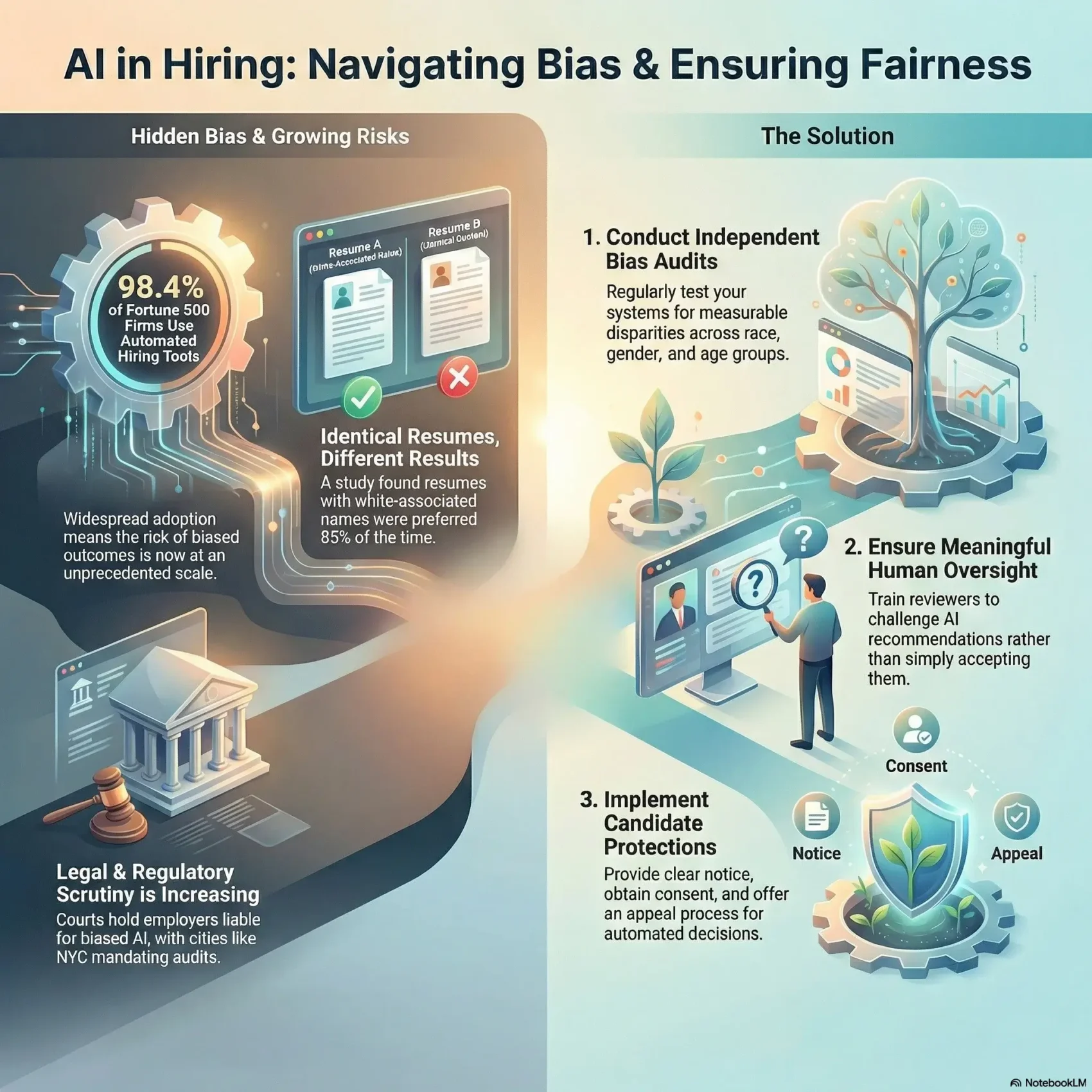
A BETTER AI ACCOUNTABILITY CHECKLIST
1. Audit the training data
Does historical data reflect old inequalities?
2. Test outcomes by gender
Are men and women being screened, promoted or rewarded at significantly different rates?
3. Examine proxy variables
Could “neutral” variables indirectly reproduce gender differences?
4. Keep humans accountable
AI recommendations should not become unquestionable decisions.
5. Allow candidates to challenge decisions
People deserve meaningful explanations when automated systems affect their careers.
6. Continuously monitor the model
An AI system isn’t “fair forever” simply because it passed one test.
The next glass ceiling may not look like a ceiling!

It may look like a rejection email.
A low candidate score.
A missing promotion recommendation.
A performance dashboard.
A chatbot’s recommendation.
A résumé that never reaches a human being.
And perhaps that is the most important shift in the conversation about women and technology.
We used to ask:
“Why aren’t there more women at the top?”
Now we also need to ask:
“Who—or what—is deciding who gets to reach the top?”
Because the future workplace will not be shaped only by human managers.
It will increasingly be shaped by systems that rank, recommend, filter, predict and decide.
If we aren’t careful, we may spend decades trying to break the glass ceiling only to discover that we accidentally built a glass algorithm underneath it.
The technology will be smarter.
The question is whether our workplaces will be fairer.
And that part, unlike the algorithm, is still entirely up to us.