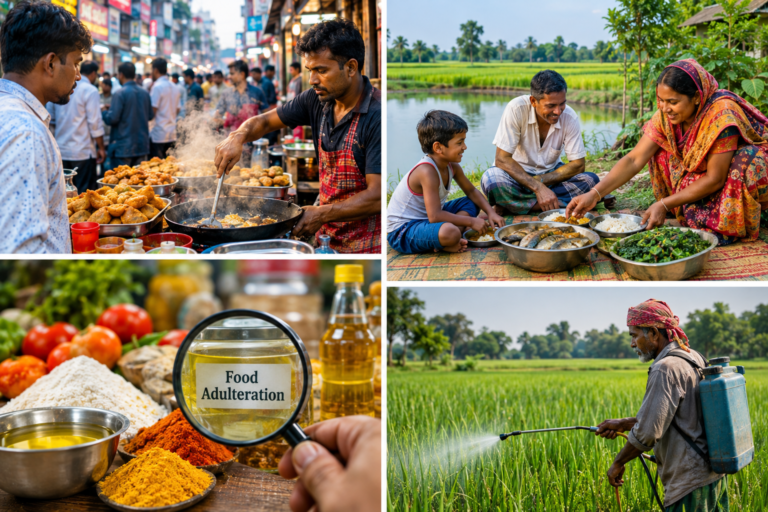
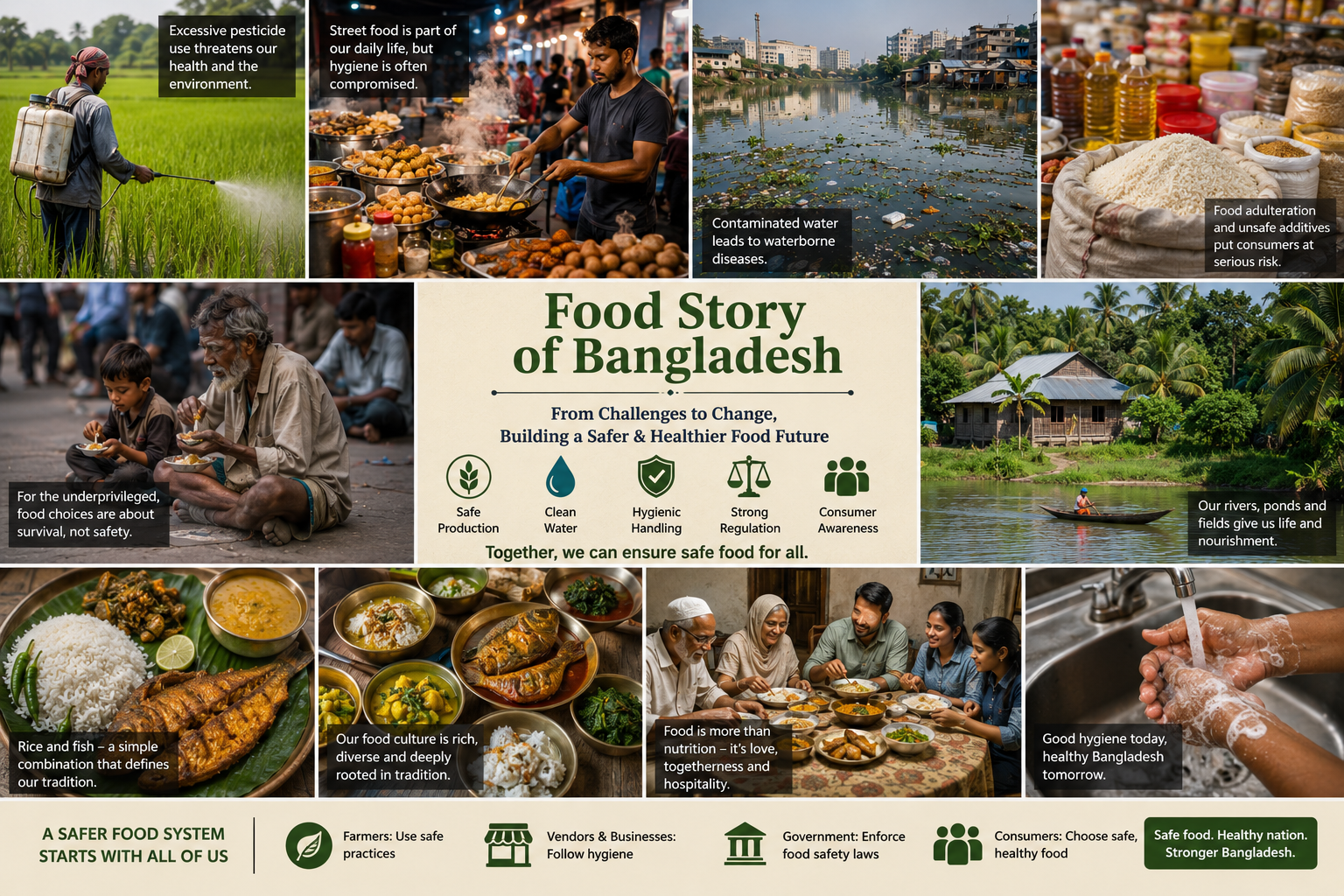
The Food Story of Bangladesh is a fascinating mix of abundance, tradition, and growing concern. Bangladesh has a deeply rooted food culture shaped by its fertile land, rivers, seasonal produce, rice fields, and remarkable variety of fish. Yet behind this rich culinary heritage lies a serious challenge: the safety and quality of the food reaching people’s plates. From food adulteration and excessive pesticide use to contaminated water and poor food-handling practices, Bangladesh’s food system faces several challenges that affect public health. For many Bangladeshis, the question is no longer simply, “What are we going to eat today?” but also, “Is this food safe?”
Bangladesh has a complicated relationship with food. On one hand, the country is blessed with fertile soil, abundant rivers, seasonal fruits, vegetables, rice fields, and an extraordinary variety of fish. Food is deeply connected to family, hospitality, culture, and even identity. On the other hand, the safety and quality of the food reaching people’s plates have become increasingly concerning.
For many Bangladeshis, the question is no longer simply, “What are we going to eat today?” It is also, “Is this food safe?”
Across the country, agricultural produce and prepared foods face a range of challenges. Microbial contamination, unsafe water, excessive pesticide use, food adulteration, poor storage practices, and inadequate enforcement of food-safety standards can all affect the quality of what people consume every day. These problems do not affect everyone equally, either. For people with limited financial resources, access to safe and nutritious food can be particularly difficult.
The result is a food system where abundance and insecurity exist side by side.
When Food Becomes a Health Risk
Food is supposed to nourish us. Yet contaminated food and water can become a major source of illness.
Waterborne and foodborne diseases remain a significant concern in Bangladesh, particularly where clean water, sanitation, refrigeration, and hygienic food preparation are difficult to maintain. Microbial contamination can occur at almost every stage of the food journey—from cultivation and harvesting to transportation, preparation, storage, and finally consumption.
Street food is one visible example.
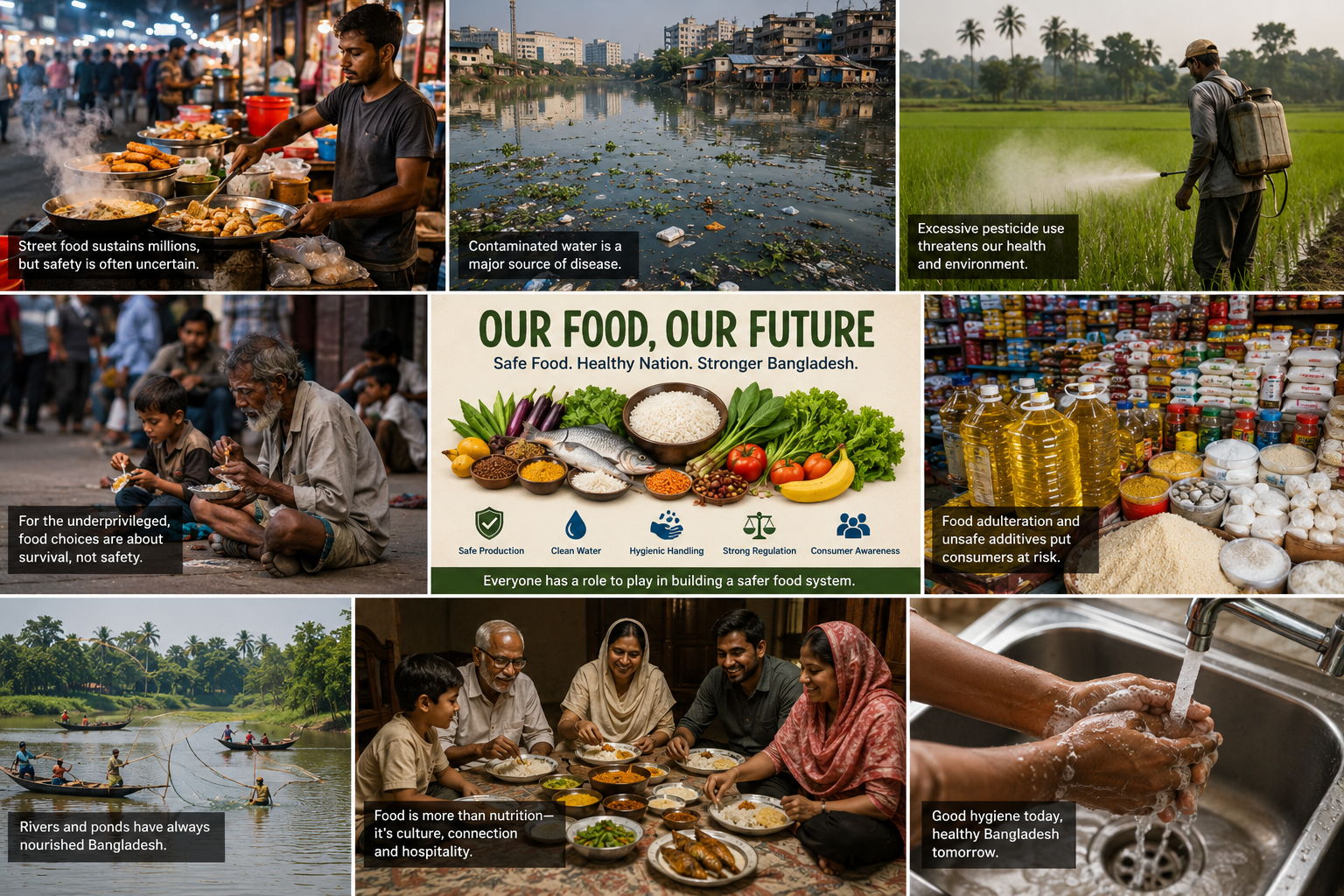
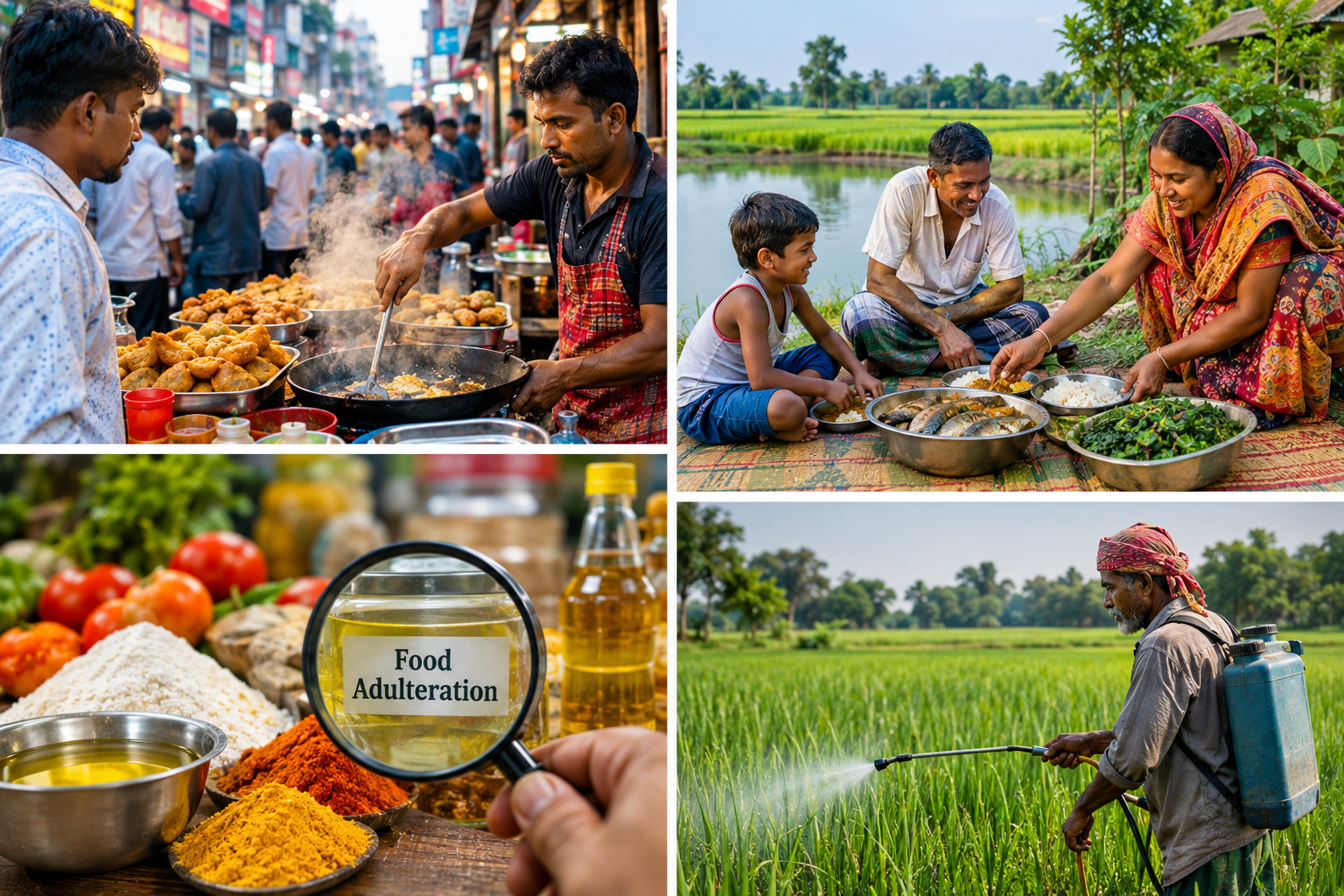
Walk through almost any busy neighbourhood in Dhaka or another major city and you will find an enormous variety of street food. From fuchka and chotpoti to fried snacks, rice dishes, grilled foods, tea, and sweets, street vendors provide affordable meals to thousands of people every day.
For many consumers, street food is not simply convenient. It is part of everyday life.
But the environment in which some street foods are prepared and served can create food-safety risks. Ingredients may be exposed to dust, polluted air, insects, contaminated water, or prolonged heat. Food may be handled repeatedly without adequate handwashing, while cooked items can sometimes remain at unsafe temperatures for extended periods.
The same problem extends beyond street food.
Water collected from contaminated sources, poorly maintained taps, ponds, canals, and other open water sources can become pathways for microorganisms that cause disease. When contaminated water is used for drinking, washing ingredients, preparing food, or cleaning utensils, the risk can spread far beyond the original source.
The People Who Depend on the Streets
The problem becomes even more complicated when we consider people whose lives are centred around the streets.
Bangladesh’s cities are home to many people who have limited access to stable housing, reliable income, refrigeration, clean water, and proper cooking facilities. For them, food choices are often determined by immediate affordability rather than nutritional value or safety.
A person with a kitchen, refrigerator, clean water supply, and a regular income has a certain level of control over what they eat. Someone living on the street may have almost none of those advantages.
For a person struggling to survive, a cheap plate of rice or a packet of leftover food can be far more important than questions about its nutritional composition or storage conditions.
In some cases, people may consume food that has been discarded, donated, or left over from restaurants, social gatherings, or other events. If such food has not been stored properly, consuming it later can carry significant health risks.
This creates a cruel cycle.
Poor people often have fewer choices, and fewer choices can mean greater exposure to unsafe food. Illness, in turn, can make it even harder for someone to work and earn money. A foodborne illness that might be a temporary inconvenience for a middle-class household can become a serious economic setback for someone who depends on daily earnings.
Food safety, therefore, is not only a public-health issue. It is also an issue of inequality.
Even Having Money Doesn’t Guarantee Safe Food
It would be easy to assume that food safety is primarily a problem for people who cannot afford better food.
Unfortunately, that is not the case.
Even people who have enough money to shop at supermarkets, traditional markets, farmers’ markets, or directly from producers may struggle to guarantee the quality of what they buy.
The problem begins long before food reaches the market.
Agricultural production can involve excessive or inappropriate use of pesticides. Fruits and vegetables may be exposed to chemicals during cultivation, while improper handling after harvesting can introduce additional contamination.
Then there is the problem of adulteration.
Food adulteration has become a persistent concern in Bangladesh. Consumers may encounter questions about the purity of products ranging from edible oils and spices to milk, fish, fruits, sweets, and processed foods. In some cases, substances may be added to increase weight, improve appearance, extend shelf life, or reduce production costs.
The motivation is often economic.
When businesses operate in a competitive environment where consumers demand low prices, some producers and traders may look for ways to reduce costs. Without effective monitoring and meaningful consequences, unethical practices can become difficult to eliminate.
And the consumer is left to deal with the consequences.
The Invisible Problem of Preservatives and Processing
Modern food systems have made it possible to move food over long distances and keep products available throughout the year. That has obvious advantages.
But convenience comes with trade-offs.
Processed foods often depend on preservatives, packaging, temperature control, and industrial processing. These technologies are not inherently harmful; in fact, many are essential for keeping food safe and extending its shelf life.
The real concern arises when food production and preservation practices are poorly controlled, misused, or inadequately monitored.
There is also a broader nutritional issue.
A food product can be technically safe to eat while still being nutritionally poor. Highly processed foods, excessive sugar, salt, unhealthy fats, and low nutritional diversity can contribute to long-term health problems.
So food safety should not be understood only as the absence of harmful bacteria or toxic substances. A healthy food system should also make nutritious food accessible and affordable.
Regulation Matters, But Enforcement Matters More
Bangladesh has institutions and laws intended to protect consumers and regulate food safety. The Bangladesh Food Safety Authority, for example, plays an important role in establishing and enforcing food-safety standards.
But having rules on paper is only part of the solution.
Effective food safety requires regular inspections, laboratory testing, traceability, transparent reporting, consumer awareness, and consistent enforcement. Producers and businesses need to know that violating food-safety standards carries real consequences.
At the same time, responsible businesses need support.
Small food vendors and farmers may not always have the resources or knowledge required to meet modern food-safety standards. Education, training, affordable testing facilities, better infrastructure, and practical guidelines can help bring them into a safer food system rather than simply punishing them after something goes wrong.
The goal should not be to destroy small businesses.
The goal should be to create an environment where making safe food is easier—and where deliberately selling unsafe food is much harder.
But Bangladesh’s Food Story Is Not Only About Problems
Despite these challenges, it would be unfair to describe Bangladesh’s food culture only through the lens of contamination and adulteration.
Food is one of the country’s greatest cultural treasures.
Bangladesh is a riverine country, and its geography has profoundly shaped its cuisine. Rivers, canals, wetlands, ponds, and fertile agricultural land have historically provided communities with fish, rice, vegetables, fruits, and other ingredients.
For generations, the combination of rice and fish has been at the heart of Bangladeshi meals.
In rural Bangladesh, the relationship between people and their food was once remarkably direct. A family might catch fish from a nearby pond or canal, collect vegetables from the garden, cook rice from locally grown grain, and serve the meal within hours.
Food did not have to travel hundreds of kilometres before reaching the dinner table.
That connection created something more than freshness.
It created familiarity.
The Taste of a Simpler Bangladesh
Older generations often remember a time when fresh fish could be obtained from a pond beside the house or from a nearby canal. Seasonal vegetables came directly from gardens or local fields. Fruits were eaten when they were naturally in season.
A meal did not necessarily need to be complicated to be satisfying.
Steaming rice, freshly caught fish, a vegetable dish, lentils, perhaps some green chillies and a little salt could make an entire family happy.
And then there was hospitality.
One of the most beautiful aspects of Bangladeshi food culture is the importance placed on feeding guests.
A visitor arriving unexpectedly at lunchtime could often expect to hear something like, “ভাত খেয়ে যেও” — “Stay and have some rice before you leave.”
It was not merely a polite phrase.
It represented an entire philosophy of hospitality.
The host might have been preparing enough food only for the family, but somehow another plate would appear. A piece of fish would be divided. Rice would be added to the plate. Someone would insist that the guest eat a little more.
Food was a way of saying, “You are welcome here.”
From River to Plate
Bangladesh’s relationship with fish is particularly important.
With its extensive network of rivers and waterways, the country developed a cuisine where fish became far more than a source of protein. Fish became part of regional identity.
Different parts of the country developed their own ways of preparing fish, influenced by local ingredients, geography, traditions, and availability.
The same fish can taste completely different depending on how it is cooked.
A simple fish curry prepared in a village kitchen can carry flavours that are difficult to reproduce in an expensive restaurant. The ingredients may be ordinary, but the freshness, cooking method, and memories attached to the dish make it extraordinary.
This is why food culture cannot be reduced to recipes.
It is also about place.
It is about the pond where the fish was caught, the field where the rice was grown, the grandmother who taught someone how to cook, and the family sitting together around the same table.
Preserving the Good While Fixing the Problems
Bangladesh does not need to choose between tradition and modernity.
The country can preserve its extraordinary food culture while building a safer and more modern food system.
Farmers need better access to information about responsible pesticide use. Food producers need practical safety standards. Vendors need access to clean water and hygienic preparation facilities. Consumers need better information about what they are buying. Regulatory agencies need the resources and authority to monitor the food chain effectively.
And perhaps most importantly, food safety needs to be treated as everyone’s responsibility.
Farmers, manufacturers, restaurant owners, street vendors, retailers, regulators, and consumers all play a role.
Technology can also become part of the solution. Better supply-chain tracking, laboratory testing, digital monitoring, improved cold-chain systems, and transparent food-quality information could help identify problems earlier and make the food system more accountable.
A Future Where Food Is Both Safe and Meaningful
Bangladesh has no shortage of food.
What it needs is a food system that makes safe, nutritious, and good-quality food accessible to everyone.
The challenge is enormous, but the opportunity is equally significant.
Imagine a Bangladesh where a farmer can produce food using responsible agricultural practices, a vendor can prepare street food with access to clean water and hygienic facilities, a consumer can trust the products they purchase, and a child—regardless of whether they live in a city, village, or on the street—can access nutritious food without unnecessary health risks.
That future would not require Bangladesh to abandon its culinary heritage.
Quite the opposite.
The country’s traditional relationship with food can become part of the solution. The emphasis on freshness, local ingredients, seasonal produce, fish, rice, vegetables, family meals, and hospitality provides a powerful foundation for building a healthier food culture.
Bangladesh’s food story is therefore a story of contrasts.
It is a story of abundance and scarcity, tradition and modernization, deliciousness and danger, resilience and vulnerability.
The country has inherited a remarkable culinary tradition from its rivers, fields, villages, and generations of cooks.
The task now is to make sure that the food reaching the next generation’s plates is not only delicious and culturally meaningful—but also safe.
Because food should never be something people have to fear.
It should be something that brings people together.